Showing posts with label By Alan. Show all posts

Wednesday, April 27, 2011

Some Final Thoughts

Having finished reading "A Farewell to Arms", I can say that it was completely different than what I was expecting. When I signed onto it in February, I expected a gripping memoir of combat written by one of the most interesting, larger-than-life characters that ever lived. When I did some background research, I expected "the worst" -- a purely romantic novel. Both were wrong. Instead I got a gripping tale of personal commitments, struggles, triumphs and failures; set against a backdrop of warfare and romance.

Not to sound too poetic or philosophical; this novel took me on an "adventure" across Italy and Switzerland, and gave me a feeling of what it was like to be in that area during the First World War. With only one WW1 veteran still with us, and with him being expected to pass away before the end of the summer, we are about to lose an important historical link. Novels such as these can help the population to understand "The Great War" - not so much the chronology, but the emotions and feelings that drove it. The novel was written during the heart of the 1920s, with its own mixture of emotions and social factors. The writing style of the novel offers insight into this. Soon most of those alive during this time will also pass on, and we will lose another link with history.

In conclusion, this novel isn't just a great storyline, it is a link with history. Regardless of your personal tastes in literature, I think anyone would appreciate - and enjoy - this work.

An Anti-War Novel?

One of the perceived key themes, if not the key theme of "A Farewell to Arms" is its strong anti-war undertones. World War One was an extremely harsh conflict, the likes of which will likely never been seen again in our lifetime. But most of the focus on the conflict relates to the Western Front, home to waist-deep mud and trenches filled with fecal material and disease. This novel is set along the Isonzo Front, in the Alps of Northern Italy. By all accounts, this front didn't have the later problems, but it produced something else: a harsh climate, and harsh terrain. As most would know, the Alps have a very harsh winter season, have valleys several thousand feet deep, and mountains that reach through the cloud bank. While initially more "romantic" and "glamorous" than the contemporary WW1 Fronts of France and Russia, you must keep in mind that these climates are better suited to adventurers, not a solider born before the turn of the 20th century. Hemingway likely was attracted to the front for this "adventure" factor. But as does the main character in the novel, Hemingway likely realized rather quickly that this is no place for war. This seems straightforward, as the book is anti-war, and this implies that Hemingway himself followed a similar ideology.

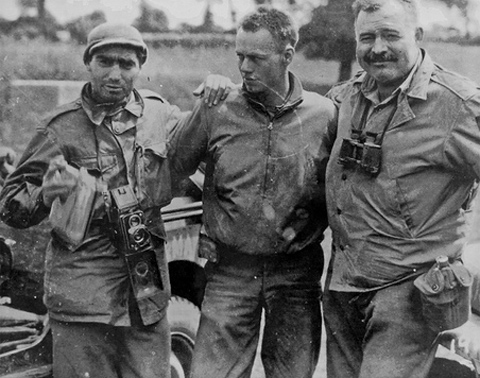
However, here is the catch: Hemingway himself wasn't an anti-war person. Indeed, 20 years later in WW2, Hemingway served as a freelance correspondent and had exploits including hunting for German U-Boats in a rigged up fishing boat off Cuba, leading a village militia in France, and attaching himself to army units led by his personal friends (seen in the photo in the top right) and staying at the front lines -- he even received the American Bronze Star for bravery under fire, only three medals below the Medal of Honor. This doesn't seem to match his perceived anti-war image.

I believe the answer is this: Hemingway liked the "classic" image of war - the one of glory on the battlefield, the average man becoming a hero, immense victories. WW1, especially the Italian Front, offered none of this. From this thought, I have been led to believe that the theme of anti-war in the novel isn't anti-war at all, but more anti-WW1.

Regardless of whether my thesis is right or wrong, as I have hopefully demonstrated, this novel provokes stimulating thoughts that are not just limited to the plot line.

Parallels?

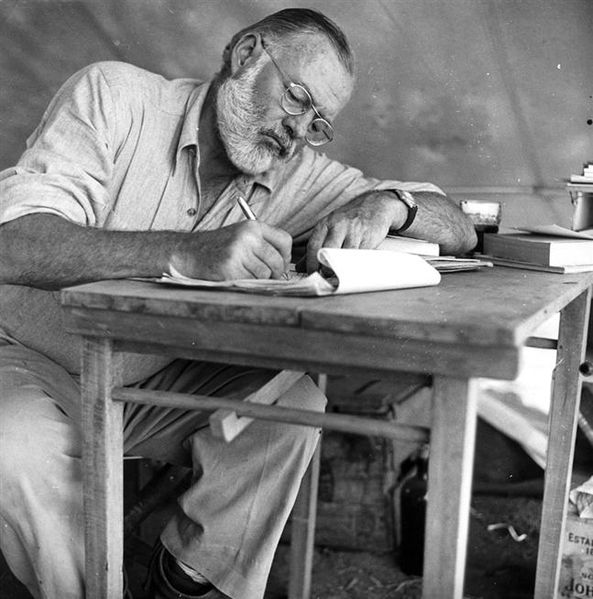
One of the things that struck me while reading "A Farewell to Arms" are the correlations between the main character, Lt. Henry, and Ernest Hemingway (pictured, to the right). Both were wounded in a similar way, both recieved the Silver Medal for Bravery, both had a relationship with a nurse in a Milan Hospital, both were involved with ambulances -- and all while they were stationed along the same [Isonzo River] front. Does this mean that we can accept Henry's thoughts and feelings are being similar to Hemingway's? We will never know the answer for certain, but I think we can. Initially, Henry is pro-war and is looking for adventure. This is likely how Hemingway felt, as he volunteered to go and serve. As the novel draws on, Henry grows weary of the war and in the end is fully opposed to it. Again, Hemingway, likely felt the same way; if he did not, then why would he author an anti-war book.

This novel makes an interesting study: not only is the plot line one of the classics of literature, but it also is strongly inspired by the exploits of the author, almost in an autobiographical fashion.

Saturday, December 4, 2010

"The war is lost"

"[von Bronikowski] watched German officers with twenty to thirty men apiece, marching back from the front – retreating towards Caen.…..'They were drunk as pigs, their faces were dirty and the swayed from side to side.' Reeling by, oblivious to everything they saw, they sang 'Deutschland uber Alles' at the top of their voices. Bronikowski watched them until they were out of sight. 'The war is lost', he said aloud."

-Pg 275

By the final hours of June 6th (American landing beach pictured top right), it had become apparent that the Germans could not push the Allied invaders out. German soldiers, shocked by the sudden appearance of dozens of allied divisions and thousands of warships, retreated in disbelief. Constant flyovers by Allied warplanes, bombing marshaling yards and strafing vehicle columns, had taken their toll. The Germans were truly crushed, and this occurred to everyone; from Rommel, who, when asked if he could throw the invaders back into the sea “shrugged, spread his hands and said ‘…I hope we can’” (Pg 277), to tank commander Colonel von Bronikowski.

Soldiers acted in different ways when faced with the reality of defeat; some merely broke down, fanatics stood their ground and went down in a blaze of allied bullets, and some turned to French alcohol, which the Germans had been compiling since their initial conquest of the nation some four years before. This quote really sums up the importance of “the longest day” - the Germans, for the first time in five years, had been dealt a defeat by the western allies in North-West Europe, and thus the disoriented Germans were on their way to a slow eleven month retreat back to Berlin itself, when the war would finally end. The Germans where routed, and Hitler's "Third Reich would have less than one year to live" (Pg 277).

By blending first-person accounts and the official records into one book, Ryan presents the history of D-Day in a way that is both interesting and gripping but at the same time lets you truly feel like you are on the front lines with the men who were there. While Ryan could have simply have stated that the Germans were dealt a serious blow from which they never recovered, by blending that thesis with first-person accounts, it has such a greater impact on the reader. This attitude has made Ryan's "The Longest Day" one of the best accounts of the D-Day landings.

“Awfully sorry, old man, but we simply landed here by accident”

"The General’s intelligence officer disarmed the two men and brought them up to the veranda. The astounded Reichert could only blurt out 'Where have you come from?' to which one of the pathfinders, with all the aplomb of a man who had just crashed a cocktail party, replied, 'Awfully sorry, old man, but we simply landed here by accident'."

-Page 116

Cornelius Ryan’s “The Longest Day” mixes both the official “big-picture” history of the D-Day landings and the personal, often humorous and unbelievable, stories that are often seen in veteran’s memoirs. Although works like this are usually immensely popular (all of Ryan’s books were New York Times bestsellers, and historians who have followed in his footsteps, such as Max Hastings, have enjoyed similar embraces), these types of books are rare; partially because of the time and effort it takes to write them. For instance, the author worked on this one for ten years – 1949 to 1959. This quote above is an example of how Ryan combines both of these.

In the hours leading up to the invasion, thousands of paratroopers were dropped behind the invasion beaches. Before these paratroopers, small teams of soldiers coined “pathfinders” (pictured, top right) were dropped. Representing the vanguard of the invasion force, their mission was to mark the landing zones for the rest of the airborne forces. However, due to high winds and disoriented pilots, these men were often dropped far off course. This quote pertains to one of these teams – who drifted far off course and landed in the front yard of 711th Infantry Division commander Josef Reichert's command post. Swiftly captured by the General’s intelligence officer, one member of the British team nonchalantly delivered the line to the astonished general, who was still completely unaware of what was unfolding before him.

"The Longest Day"

“The first twenty-four hours of the invasion will be decisive….the fate of Germany depends on the outcome…..for the Allies, as well as Germany, it will be the Longest Day"

-Erwin Rommel on April 22, 1944 (pictured, to the right)

Often in history, victory and defeat will hinge on a few critical hours. These hours can ensure victory, or seal defeat. At perhaps no other time is this more evident than the events of June 6th 1944, better known as Operation Overlord, or the D-Day landings. The defeat of the Nazi regime in Europe was sealed by hundreds of thousands of men; men from every walk of life, who came together to do something extraordinary - something that will likely never be equalled in our lifetime.

This quote; told to the author, Cornelius Ryan, by Field Marshall Erwin Rommel’s former aide Captain Hellmuth Lang, is where the book get’s its name from. Once the famed “Desert Fox” who lead the Wehrrmacht in a string of victories across North Africa, Rommel is now in charge of defending occupied Western Europe from Allied invaders. Rommel, a student of history as well as a skilled tactician, is acutely aware that any invasion must be halted before the enemy can take a foothold. He believes that there is “only one chance to stop the enemy and that’s while he’s in the water” (Pg 27). Henceforth began the fortification of the coast, the maze of bunkers, trenches and dug in artillery – the things which were to soon become synonymous with any invasion. No longer in the Second World War, would an invading force be permitted a relatively unobstructed amphibious assault. The date of the invasion – yet unknown to Rommel and his commanders – was truly to become the longest day; and the one which sealed the defeat of Hitler’s regime.

This quote provides an excellent prelude to the book itself, as it is a rather foreboding outlook by Erwin Rommel, the man on whom the future of Europe hinged. Knowing the outcome of the battle, it carries even more weight, and makes you think about what could have been if the Field Marshall had his way and had not been limited by his own commanders.

Through this quote and the next two, I hope to give everyone a good feel of what the book is like, and a rough idea of how things progressed that day. This quote provides a view of the situation before the battle (feverish preparations), the next deals with the start of the landings (confusion for the Germans, optimism from the allies), and the last offers closure on the situation (Germans routed, in disoriented retreat).

Monday, September 13, 2010

Does quality literature endure?

“Literature doesn’t evolve or improve or progress.” (p. 9)

Frye is saying that literature doesn't improve over time - the style remains constant. In other words, a good book now will still be a good book in a hundred years (Shakespeare is used as an example). There is no "new" style of literature - it is something that will endure until the end of time.

I agree with Frye's point. Many of the most popular (and/or "classic") books today (works of F. Scott Fitzgerald, Ernest Hemingway in addition to non-fictional texts and biographies), were written over several decades ago. In the case of Shakespeare and the Greek philosophical plays, these were written over hundreds and thousands of years ago, respectively. It is clear that literature does not age - in fact, some of (in my opinion) the best history books are those written in the immediate post-WWII era - some 60 years from today. The fact that many new books are "popular" and "bestsellers" doesn't necessarily mean that they will eclipse the level of enjoyment offered by the old classics. The paraphrase McCullough, "even a old book is new to the person who opens it for the first time".

In this regard, Frye seems to be agreeing with McCullough - if literature doesn't evolve, the level of enjoyment must clearly be the same as the day the book was released. Although their philosophical views on how we learn are different: Frye claims that we learn mostly from the society in which we live in, while McCullough's view is very "book-oriented". However, the fact that two very different people (historian and a reviewer) from very different time periods (1960s vs present-day) agree that literature never ages, adds yet another piece of supporting evidence to Frye's claim.